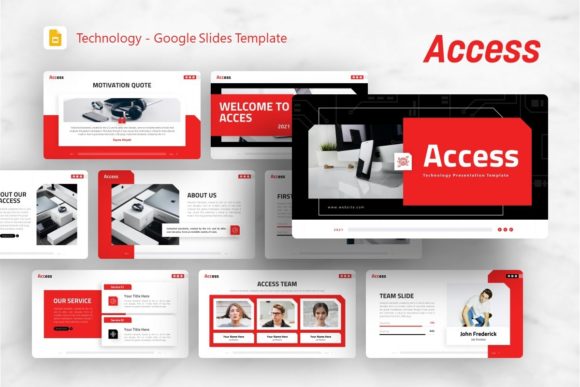
Access Technology Presentation: A Comprehensive Google Slides Template for Modern Visual Communication
In the current digital landscape, the ability to convey complex information through clean, accessible, and visually engaging slides is a critical skill for professionals across all sectors. The Google Slides Template - Access serves as a foundational tool designed to bridge the gap between raw data and compelling narrative. While originally conceptualized with technology and accessibility in mind, this template ecosystem has evolved into a versatile asset suitable for creative agencies, corporate profiles, startups, and personal portfolios. Understanding the structural integrity and functional depth of this template allows users to leverage it not merely as a design backdrop, but as a strategic communication framework that enhances audience retention and message clarity.
Versatile Applications Across Professional Domains
The primary strength of the Access template lies in its adaptability. Unlike niche-specific themes that force content into rigid boxes, this presentation system supports a wide spectrum of use cases. For creative agencies and design firms, the template provides a minimalist canvas that highlights portfolio work without visual clutter. The grid systems and typography choices are calibrated to let photography and creative assets take center stage, ensuring that the designer’s work remains the focal point rather than the slide decoration.
In the corporate and business sector, the template functions as a robust vehicle for company profiles and internal reporting. The inclusion of handcrafted infographics allows organizations to transform quarterly results, market analysis, or operational workflows into digestible visual formats. This is particularly relevant for pitch decks and startup presentations where investors require rapid comprehension of business models and financial projections. The structured layout guides the presenter through a logical flow, from problem identification to solution proposal, reducing cognitive load for stakeholders evaluating new ventures.
Educators and researchers also find significant utility in this framework. Academic presentations often suffer from text density and poor hierarchy. The Access template’s master slide architecture enforces consistency and readability, making it easier to present research findings, lecture materials, or conference talks. Furthermore, individuals building personal portfolios can utilize the specific layout variations designed for biography, skill sets, and project showcases, creating a cohesive personal brand identity that translates well in both digital and live presentation settings.
Technical Architecture and Customization Capabilities
Beyond aesthetic appeal, the practical value of any presentation template is determined by its technical flexibility. The Google Slides Template - Access is engineered with 36 distinct slides per template variation, providing a comprehensive library of layouts that cover virtually every presentation need. This volume ensures that users are not forced to duplicate and manually adjust slides, which often leads to formatting inconsistencies. Instead, they can select purpose-built layouts for timelines, team introductions, data visualization, and closing arguments.
The customization engine relies heavily on Master Slides. This feature is essential for maintaining brand consistency across large decks. By editing the master slide, users can globally update logos, color palettes, fonts, and footer information across all 36 slides instantly. This capability significantly reduces the time spent on manual formatting and minimizes the risk of errors during high-pressure preparation periods. Additionally, all graphics within the template are vector-based or fully editable shapes. This means that illustrations can be resized infinitely without pixelation and recolored to match specific brand guidelines directly within the Google Slides interface, eliminating the need for external graphic design software.
Picture placeholders utilize a drag-and-drop functionality that streamlines the image insertion process. Rather than cropping and masking images externally, users can simply drop their media into designated frames where it automatically conforms to the intended aspect ratio and shape. This workflow optimization is crucial for teams that need to iterate quickly on deck content while maintaining professional polish.
The Role of Handcrafted Infographics in Data Storytelling
Data visualization is a cornerstone of effective modern presentations, and the Access template distinguishes itself through handcrafted infographic elements. In an era where AI-generated graphics can sometimes feel generic or disconnected from context, curated vector illustrations provide a level of intentionality and cohesion that enhances credibility. These infographics are not static images; they are constructed from editable PowerPoint-style shapes adapted for the Google Slides environment.
This editability allows presenters to tailor data representations to their specific narrative. For example, a circular progress chart can be adjusted to reflect exact percentages, colors can be shifted to indicate different categories, and labels can be modified without breaking the visual alignment. This level of control ensures that the visual aid accurately reflects the underlying data rather than serving as mere decoration. When presenting complex concepts such as technological integration, user journeys, or market segmentation, these bespoke visuals help anchor abstract ideas in concrete imagery, facilitating better understanding among diverse audience members.
File Ecosystem and Asset Management
Successful implementation of a presentation template depends on having access to all necessary supporting assets. The Access template package is structured to provide a complete ecosystem rather than just a slide file. Users receive the core .PPTX file, which maintains compatibility for those who prefer Microsoft PowerPoint while remaining fully convertible to Google Slides. This dual-compatibility approach broadens the template's utility across organizations with mixed software environments.
Crucially, the package includes a documentation file that serves as a user manual. This resource is invaluable for unlocking advanced features, understanding layer structures, and troubleshooting common customization issues. It transforms the template from a static product into a learnable tool. Additionally, a dedicated vector icon set is included, allowing users to supplement the pre-designed slides with consistent iconography for bullet points, headers, and custom diagrams. This ensures that even newly created content maintains the same visual language as the original template.
It is important to note regarding asset management that demo images are for preview purposes only and are not included in the downloadable files. This distinction encourages users to populate the template with their own authentic imagery, which is vital for SEO and user engagement. Original photography and proprietary graphics signal expertise and authenticity to audiences, whereas stock photography can sometimes undermine the perceived value of a presentation. The template’s picture placeholders are specifically sized to accommodate standard web and print resolutions, guiding users toward optimal image quality.
Strategic Considerations for Implementation
While the Google Slides Template - Access offers extensive features, maximizing its effectiveness requires strategic consideration of content hierarchy and audience needs. The 36-slide library should be viewed as a menu of options rather than a mandatory checklist. Effective presenters curate their selection based on the narrative arc, choosing only those layouts that serve the specific message. Overloading a deck with varied slide types simply because they are available can create visual fatigue and distract from the core message.
Accessibility should remain a priority when customizing this template. Although the design is labeled "Access," true accessibility is achieved through user choices. Presenters must ensure sufficient color contrast when modifying the palette, use alt text for all inserted images and infographics, and maintain readable font sizes. The template’s clean lines and generous whitespace naturally support accessibility standards, but these benefits can be negated if customization introduces low-contrast text or overly dense information clusters.
For startups and pitch deck creators, the template’s structure supports the standard venture capital narrative flow. However, users should resist the temptation to fill every placeholder. White space is an active design element that directs attention. In sections detailing market opportunity or competitive advantage, allowing key statistics to breathe against a clean background often has more impact than filling the slide with additional decorative elements. The pixel-perfect illustrations provided are most effective when used sparingly to emphasize critical transitions or concepts.
Optimizing Workflow for Teams and Individuals
The collaborative nature of Google Slides makes this template particularly powerful for team environments. Because the template is built on master slides, marketing teams can establish a locked brand layer that prevents individual contributors from accidentally altering core visual identities. Content creators can then focus solely on text and data entry within the safe zones defined by the master layout. This separation of concerns streamlines the review process and ensures that final outputs always meet organizational standards.
For individual users, such as freelancers or students, the template serves as a design education tool. By deconstructing how the master slides are built and how the infographics are assembled, users can develop a deeper understanding of presentation design principles. The documentation file acts as a guide, but exploring the file structure itself reveals best practices in layer organization, grouping, and alignment. This knowledge transfers beyond the specific template, improving the user’s general ability to create effective visual communications in any platform.
Ultimately, the Google Slides Template - Access represents a convergence of form and function. It addresses the practical needs of diverse users—from photographers showcasing portfolios to executives reporting on KPIs—through a unified, technically robust system. By leveraging its 36-slide variety, editable vector assets, and master slide architecture, presenters can reduce production time while elevating the professional quality of their output. The key to success lies not in the template itself, but in the thoughtful application of its features to create clear, accessible, and impactful narratives that resonate with target audiences.