Enhancing Healthcare Design with Versatile Medical Treatment Icons
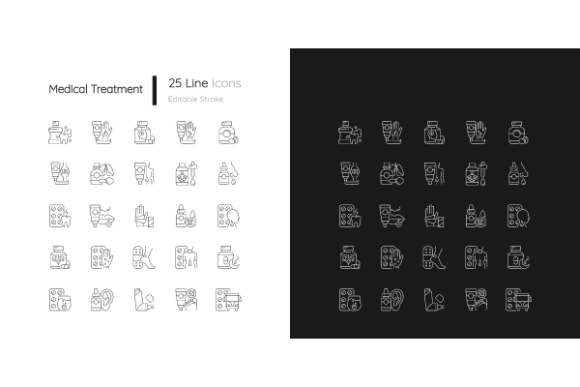
In the rapidly evolving landscape of digital health and medical communication, visual clarity is not merely an aesthetic choice; it is a functional necessity. Whether designing a patient education brochure, a telemedicine mobile application, or an informational website for a pharmaceutical company, the ability to convey complex medical concepts quickly and accurately is paramount. This is where a comprehensive Medical Treatment Icons Bundle becomes an indispensable asset for designers and healthcare professionals alike. Specifically, collections featuring medical treatment linear icons bundle for dark and light mode address the modern demand for adaptive, accessible, and professional user interfaces.
Understanding the significance of these visual tools requires looking beyond simple decoration. Icons serve as a universal language that bridges the gap between technical medical terminology and patient comprehension. When utilized correctly, customizable thin line symbols can reduce cognitive load, improve navigation, and establish trust. This article explores the foundational elements of medical iconography, the technical advantages of editable vector assets, and how resources from providers like BSD Studio are transforming design workflows in the healthcare sector.
The Critical Role of Visual Communication in Medicine
Medical information is often dense, intimidating, and emotionally charged for patients. In this context, design serves a therapeutic function by organizing chaos into understandable segments. A well-designed icon set acts as a visual anchor, helping users identify content categories such as oral hygiene, antibacterial ointments, or pain reliever protocols without needing to read extensive text blocks immediately.
For general readers and design beginners, it is important to understand that medical icons differ significantly from generic symbol sets. They require a higher degree of accuracy and sensitivity. An icon representing a specific treatment must be anatomically suggestive yet stylized enough to remain clean at small sizes. Furthermore, these symbols must maintain neutrality and professionalism. Unlike playful icons used in gaming or social media, medical linear icons must convey safety, precision, and clinical authority. This balance is achieved through isolated vector outline illustrations that prioritize legibility over ornamentation.
Adapting to Modern Interface Standards: Dark and Light Modes
One of the most significant shifts in contemporary UI/UX design is the ubiquity of dark mode. Users now expect applications and websites to respect their system preferences, switching seamlessly between high-contrast light themes and eye-friendly dark themes. A static icon set designed solely for a white background fails in this environment, often becoming invisible or causing eye strain against a dark backdrop.
A premium medical treatment linear icons bundle for dark and light mode solves this problem at the source. Rather than requiring designers to manually invert colors or redraw assets, these bundles provide optimized variations for both environments. This ensures that whether a patient is checking dosage instructions on a bright hospital screen or reviewing post-op care on a dimly lit phone at night, the visual hierarchy remains intact. This adaptability is not just about aesthetics; it is a core component of digital accessibility, ensuring that visually impaired users or those with light sensitivity can access vital health information comfortably.
Technical Flexibility: The Power of Editable Vectors
For experienced designers and developers, the file format of an icon library is just as important as the visual style. Raster images (like standard JPEGs) have fixed resolutions and cannot be modified without quality loss. In contrast, the industry standard for medical iconography relies on scalable vector formats. The availability of files in JPEG, AI, PNG, EPS, and SVG formats ensures compatibility across every stage of the production pipeline.
- SVG (Scalable Vector Graphics): The gold standard for web and app development. SVGs are code-based, meaning they scale infinitely without pixelation and can be animated or styled via CSS. They are essential for responsive medical dashboards.
- AI (Adobe Illustrator) & EPS: These source files allow for deep customization. Because these are customizable thin line symbols with editable stroke properties, a designer can adjust the weight of the lines to match a brand’s specific typography or visual identity. If a project requires a bolder look for print or a finer line for high-density screens, the stroke can be modified globally in seconds.
- PNG & JPEG: While less flexible, these raster formats remain useful for quick mockups, presentations, or legacy software integration where vector support is limited. Having them included in the bundle saves time on export tasks.
The concept of an editable stroke deserves special emphasis. In linear icon design, the relationship between the line thickness and the negative space defines readability. Being able to adjust this parameter non-destructively allows teams to future-proof their designs. As display technologies evolve and pixel densities increase, having source files that can be refined rather than replaced represents a significant long-term value.
Specific Use Cases in Healthcare Design
To truly appreciate the utility of this collection, one must consider its practical applications across different media. The versatility of isolated vector outline illustrations makes them suitable for a vast array of projects:
- Mobile App Screen Pages: Telehealth apps rely on intuitive navigation. Icons for appointments, prescriptions, and emergency contacts must be instantly recognizable. Linear icons occupy minimal screen real estate, leaving more room for critical patient data.
- Brochure Templates and Print Media: Patient discharge papers and educational pamphlets benefit from visual cues that break up walls of text. A section on wound care accompanied by an antibacterial ointment icon improves retention and compliance.
- Infographic Elements: Public health campaigns often need to explain statistical data or procedural steps. Consistent iconography ties disparate data points together, creating a cohesive narrative that guides the viewer through complex information.
- Wayfinding and Signage: Physical clinics use digital displays and printed signage to direct patients. High-contrast linear icons work effectively in both large-format printing and digital kiosks.
Streamlining Workflow with Professional Resources
Time is a finite resource in any creative or medical project. Creating bespoke medical icons from scratch is a labor-intensive process that requires specialized illustration skills and medical knowledge to ensure accuracy. This is why professional studios exist to bridge the gap between creativity and efficiency.
BSD Studio exemplifies this supportive role in the design ecosystem. By providing a curated variety of products, topics, and file types, they ensure that there is always something new available for emerging healthcare trends. When you count on us in search for icons, brochure templates, infographic elements, mobile app screen pages and so much more, you are leveraging a library built on expertise. The goal is to help you find what you need in our shop to make sure you are saving time on design work while keeping up top quality.
This efficiency does not come at the cost of uniqueness. Because the assets are fully editable vectors, they serve as a sophisticated foundation rather than a rigid template. Designers can take a base icon for oral hygiene and customize it to match the exact branding guidelines of a dental chain, or adapt a pain reliever symbol to fit the color palette of a specific pharmacy network. This hybrid approach—using professional base assets with custom modifications—is the hallmark of modern, efficient design workflows.
Best Practices for Implementing Medical Icons
Even with the highest quality assets, implementation matters. To maximize the effectiveness of your Medical Treatment Icons Bundle, consider the following best practices:
- Maintain Consistency: Never mix linear icons with filled or glyph styles within the same interface. Stick to the customizable thin line aesthetic throughout to maintain visual harmony.
- Prioritize Accessibility: Always include alt-text for digital icons. While the icon conveys meaning visually, screen readers require text descriptions. Ensure the contrast ratio meets WCAG standards, especially when utilizing dark mode variations.
- Test at Multiple Sizes: Medical icons often appear in footnotes as well as headers. Test your editable strokes to ensure the icon remains legible at 16px as well as 128px.
- Cultural Sensitivity: Medical symbols can carry different connotations globally. Using standardized, abstract linear representations helps minimize cultural misinterpretation compared to realistic illustrations.
Conclusion
The intersection of healthcare and design is a space where clarity saves time and potentially improves outcomes. A robust Medical Treatment Icons Bundle is more than a collection of pretty pictures; it is a functional toolkit for communication. By offering medical treatment linear icons bundle for dark and light mode, editable vector formats like AI, EPS, and SVG, and specific categories ranging from oral hygiene to pain relievers, these resources empower creators to build better, more accessible health experiences.
Whether you are a seasoned UI designer building the next generation of health tech, or a marketing manager creating educational materials, the right visual assets are foundational to your success. BSD Studio provides a variety of products, topics and file types so that there’s always something new to inspire and facilitate your work. Embrace the efficiency of professional, customizable iconography, and focus your energy on what matters most: delivering clear, compassionate, and effective medical communication.